

25 signatures reached
To: Queensland government
Restricting Bicycle Use on Roads Where Safe Traffic Flow Cannot Be Maintained
To the Queensland Parliament and the Queensland Government,
We, the undersigned, call on the Queensland Government to review the current rules governing bicycle use on Queensland roads and introduce clearer restrictions on cycling on roads where bicycles cannot safely operate without creating a significant obstruction or traffic hazard.
Background
Under Queensland’s current road rules, bicycles are considered vehicles and generally have the same right to use Queensland roads as other vehicles. Queensland also requires motorists to provide cyclists with a minimum passing distance of 1 metre on roads with speed limits of 60 km/h or less, and 1.5 metres on roads with speed limits above 60 km/h.
These rules are intended to protect vulnerable road users. However, they can create significant safety issues on roads that were not designed to accommodate large differences in vehicle speeds.
On some Queensland roads, particularly narrow high-speed roads, motorists may be travelling at 80, 90 or 100 km/h while cyclists may be travelling substantially slower. Where there is insufficient shoulder width, limited visibility, heavy traffic or no safe opportunity to overtake, motorists can be forced to remain behind a cyclist for extended periods or undertake manoeuvres to pass safely.
Queensland’s own road rules already recognise the principle that road users must not create a traffic hazard or unreasonably obstruct other road users.
We believe this principle should be applied more clearly to roads where the physical characteristics and traffic environment make cycling inherently incompatible with safe traffic flow.
We petition the Queensland Government to:
1. Establish clear criteria for roads unsuitable for cycling
Introduce an evidence-based assessment system to identify roads where cycling presents an unreasonable safety risk.
The assessment should consider:
- Posted speed limit;
- Typical traffic speeds;
- Road width;
- Available shoulder width;
- Traffic volume;
- Heavy vehicle traffic;
- Visibility and sight distance;
- Number and frequency of safe overtaking opportunities;
- Road geometry, including blind corners and crests;
- Crash history; and
- Availability of safer alternative cycling routes.
2. Introduce restrictions on cycling on unsuitable high-speed roads
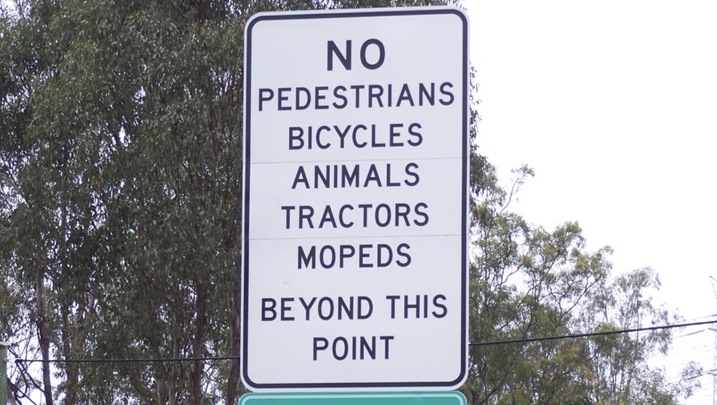
Where a road is determined to be unsuitable for cycling, Queensland should have the ability to prohibit or restrict bicycle use through appropriate signage and regulation.
This should particularly apply where a cyclist travelling at normal cycling speeds cannot reasonably maintain safe traffic flow and motorists cannot safely provide the legally required passing distance without significant risk.
3. Introduce a “safe operating speed” principle
Cyclists should not be permitted to use roads where the normal speed differential between bicycles and other traffic creates an unreasonable and foreseeable safety hazard.
Rather than establishing an arbitrary minimum cycling speed for every road, the Government should consider the combination of traffic speed, road design and the cyclist’s ability to safely avoid obstructing traffic.
4. Provide practical alternative routes
Where cycling restrictions are introduced, the Government should identify or provide a reasonably practical alternative route wherever possible.
The purpose of these reforms should not be to prevent cycling. It should be to ensure cyclists are directed towards roads and paths where they can ride safely without placing themselves or other road users in an unnecessarily hazardous situation.
5. Review existing cycling infrastructure
Queensland should prioritise separated cycling infrastructure alongside major high-speed roads where there is significant demand for cycling.
Where a suitable separated path or lower-speed alternative route exists, consideration should be given to directing cyclists away from high-speed roads where the interaction between bicycles and motor vehicles creates an unacceptable safety risk.
This petition is not anti-cyclist
We recognise that cyclists are legitimate road users and that motorists have a responsibility to drive safely around them.
We also recognise that Queensland’s minimum passing-distance laws are important protections for cyclists. On roads above 60 km/h, motorists must provide at least 1.5 metres when passing a cyclist, and motorists are permitted to cross centre lines when it is safe to do so. If it is not safe to pass, motorists must wait.
However, a legal right to use a road does not necessarily mean that every road is an appropriate or safe environment for every type of vehicle.
A bicycle travelling at 20–40 km/h on a road carrying traffic at 80–100 km/h can create a substantial speed differential. On a wide multi-lane road this may present little difficulty. On a narrow, winding or heavily trafficked road, the same speed differential can create repeated situations in which motorists are required to slow dramatically and wait for a safe opportunity to pass.
These conditions can increase frustration, congestion and the likelihood of dangerous overtaking behaviour.
We believe it is preferable to prevent these conflicts through sensible road-use restrictions and better route planning, rather than relying entirely on motorists and cyclists to manage dangerous situations after they occur.
Why is this important?
Our request
We therefore call on the Queensland Government to review the current bicycle road-access framework and introduce a system that identifies roads where cycling is incompatible with safe traffic movement.
The goal should be:
Safe roads for cyclists. Safe roads for motorists. Fewer dangerous interactions between the two.
Cyclists should be encouraged and supported to ride on roads where they can do so safely, while roads that are unsuitable for slow-moving bicycles should be appropriately restricted or provided with safer alternative routes.
We respectfully ask the Queensland Parliament to investigate this issue and consider amendments to Queensland’s road rules and road-management policies to improve safety for all Queensland road users.