
To: The Federal Treasurer
Ask a Customer Owned Bank to run a Regulated Trial on New Rules for Home Loans
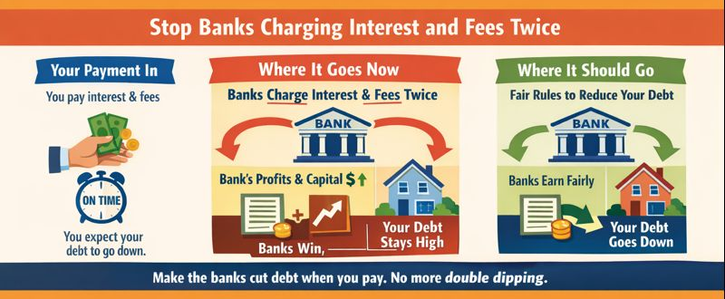
We call on the Treasurer to instigate a banking trial.
Require one Major Australian Customer-Owned Mutual Banks to run a government-funded, regulated trial in which, for a limited set of existing home loans, interest and fees are treated strictly as service charges and not capitalised into bank equity, with the economic outcomes publicly reported.
Require one Major Australian Customer-Owned Mutual Banks to run a government-funded, regulated trial in which, for a limited set of existing home loans, interest and fees are treated strictly as service charges and not capitalised into bank equity, with the economic outcomes publicly reported.
Why is this important?
When Australians make their home loan or credit card payments, they expect their debt to go down.
But under current banking algorithms, that does not always happen.
When the bank debits your loan account for interest, it extends your loan by that amount. Instead of cancelling that debt when you pay it, it leaves the credit on the loan. It means your payment strengthens the bank's balance sheet, while your interest remains unpaid.
In everyday terms, the bank treats your payment as though they had supplied it to you because they covered the cost of the money while you used it. That is not how fair accounting should work. When you pay interest and fees, the bank should recognise that you have paid them.
You can check your own loan or credit card account. Get the opening balance for the month, add the interest and fee debits to your balance, add any other debits, subtract your payments, and see whether the balance shows the payment of interest and fees.
Banks receive government-issued money at face value: one dollar costs one dollar. Households, however, must repay more than face value because interest and fees are capitalised into loans. This is a design choice, not an economic necessity. Money should be sold at its face value, with bank services paid separately.
Banks receive government-issued money at face value: one dollar costs one dollar. Households, however, must repay more than face value because interest and fees are capitalised into loans. This is a design choice, not an economic necessity. Money should be sold at its face value, with bank services paid separately.